
Hillsborough County residents are being asked to expect more helicopter activity overhead this week as local officials step up mosquito control efforts in response to a growing dengue fever outbreak.
The county announced Sunday that aerial and ground spraying will take place Monday through Friday during daytime hours. The targeted treatment areas include East Lake, East Tampa, Palm River, and West Bloomingdale.
What Is dengue and should you be worried?Dr. Steven Goldberg, chief medical officer at Health Track the nation's leader in outpatient infectious disease testing says the situation is serious, but residents shouldn't panic.
"Dengue is very, very serious, and sadly, one person locally died from a bite by a mosquito that carried dengue," he said. "So this is very serious. That said, overall numbers are small, and there are good strategies to make it less likely you get bit."
What are the symptoms?Dr. Goldberg says most people who are bitten won't develop severe illness but knowing the warning signs is critical.
"Most people, if they get bit, will just have a local reaction, and they'll have a little swelling, maybe some soreness, and rest and acetaminophen is usually enough. Some will have a severe reaction, and that happens about 5 to 7 days after the bite," he said. "You'll get fever, muscle aches, joint pain, headache. You might get pain behind the eyes, a rash. And if that's happening, that's more serious. That warrants a practitioner evaluation."
If you think you may have been infected, Dr. Goldberg says don't wait.
"If someone is bit by a mosquito and they're concerned that they might have dengue, they need to go and get a diagnosis, and that's usually done by a swab and or a blood test.," he said.
Why is Tampa Bay being hit so hard?Dr. Goldberg says there's no single explanation, but travel and climate are the two biggest contributing factors.
"A couple of cases are likely coming from people who've traveled abroad, likely Cuba, and brought it into the area," he said. "And then the mosquito bites them and then bites someone else, and that dengue infection is transmitted. That's likely the most common cause. That said, what's happening in the environment is that it's warmer and it's been more humid. Both of those create environments for mosquitoes to grow."
And looking ahead, he says climate change could make things worse.
"It seems to be the case, and the two main factors are the interval of warm air is extended and also the interval of soaked area, humid area is extended, and those two factors support mosquito growth," he said.
Residents reactFor Vera Ginsberg, who lives in Bloomingdale Hills, the mosquito problem is nothing new. She and her dog Tabby have dealt with heavy mosquito activity in the neighborhood for some time.
"A lot of times I'll even cover up a bit more than wearing my shorts and everything, because sometimes you have a mosquito on you and you know we've been concerned," she said.
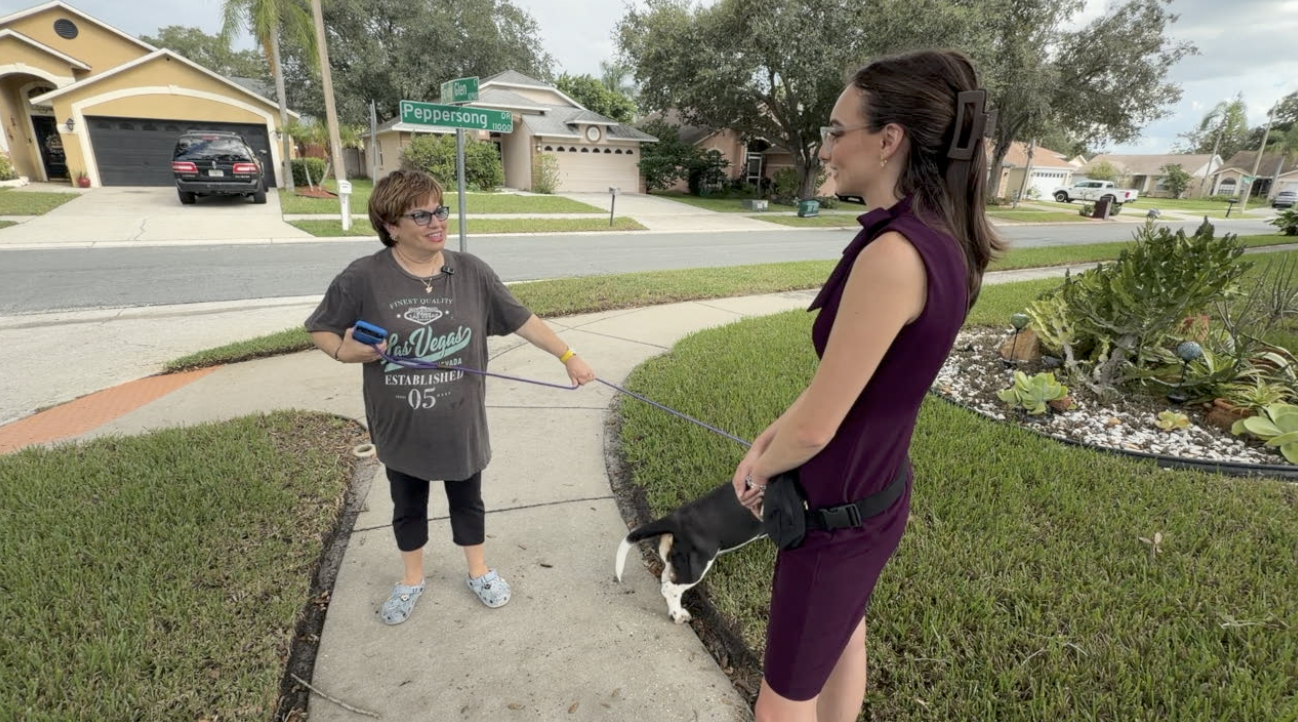
Ginsberg says she welcomes the county's increased efforts and wants to see the helicopters out more often.
"I just said let's get them out and get it, get it down," she said.
A record-breaking outbreakThe increased control efforts come as the Associated Press reports that Florida's dengue outbreak is the largest in the continental United States in decades putting added urgency behind the county's response.
Is the spraying safe?County officials say the liquid being used is safe for humans, pets and the environment. Dr. Goldberg agrees and says the treatments are an important tool.
"We would call those environmental control efforts, and they are very effective to knock down the mosquito population," he said. "And I would have people use common sense. So if your home or street has just been sprayed, stay inside and let the chemicals settle. But in general, they are a key factor to knock down the mosquito population."
Who is most at risk?Dr. Goldberg warns that while there is no cure for dengue, the most vulnerable populations need to take extra precautions.
"There's no treatment for dengue, right? It's a viral illness. There's not a therapeutic that can kill the organism," he said. "What happens if someone's seriously ill, they have to get supportive care in a hospital or intensive care unit. And the very young and the very old are those that are at highest risk."
He also notes there is currently no widely available vaccine.
"There's not a vaccine available for dengue. There are several different types of dengue, and if you get bit by a mosquito that carries, for example, dengue type one, it's not likely you're gonna get dengue type one again," he said. "However, there are several other types of dengue, and in fact, you might have elevated risk of getting another subtype infection."
How to protect yourselfDr. Goldberg says protecting yourself requires thinking about mosquito exposure around the clock.
"You have to think about this as something that can occur 24 hours a day, both day and night," he said. "Key steps are using insect repellent and EPA approved insect repellent such as DEET or picaridin. Second, wear clothing, cover all extremities, loose clothing. And third, think about water areas that are accumulating in your backyard, such as a bird feeder, and make sure those are changed weekly. Those are some key strategies to protect yourself."
For more information on dengue fever from the Florida Department of Health visit this page.


