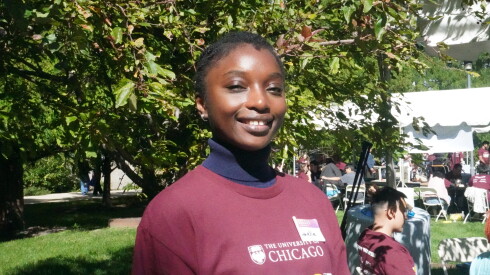
Thousands of kids and adults stepped into the white coats of University of Chicago students and researchers on Saturday for the fifth annual South Side Science Festival.
More than 130 hands-on demonstrations and activities ranging in disciplines from biology, aerospace, physics and more spanned the campus, allowing children and adults to play games, conduct experiments and ask questions of professional scientists.
The South Side Science Festival was inspired by The Long Night of Sciences — a public science festival in Germany where universities and research labs open their doors to the public. Organizers say the event intends to close the gap between the South Side community and researchers by demonstrating that science is for everyone.
“We wanted to replicate [The Long Night of Sciences festival],” said Maanasa Raghavan, associate professor in the Department of Human Genetics and a founding organizer. “But at the same time, make it very focused on our communities here on the south side.”
Raghavan says polarizing opinions about the role of science professionals and federal funding cuts in science can be demoralizing, but seeing thousands of people engaging at their annual festival is a reminder of how important their work is.
“We may be fostering young scientists,” she said. “That's why we're here, and we'll keep showing up.”
Organizer Luke Dyer says the festival was also a direct response to general fears and distrust in medicine following the initial COVID-19 outbreak.
“The idea is to bring people in and show them the science that's happening [at the University of Chicago], and also answer their questions,” he said.
PhD student Michelle Bessiake has led demonstrations at the festival for the past three years. As a researcher, she says she can spend upwards of 60 hours a week researching and running experiments, but volunteering at the festival drives her to do better work.
“These long, hard days of doing experiments — you come out here, you see what matters to people, it grounds us really,” Bessiake said.
She loves experiencing the moment it all clicks: where people begin to understand how and why scientists do what they do.
“The kids are playing with slime — they’re also asking questions,” Bessiake said. “And they're like, ‘Oh, that's why I should get vaccinated.’”
South suburb resident Nijel Mottley said his 4 year-old son loves mixing things and watching science shows on YouTube.
“He's pretty hands-on so he’s really enjoying it,” Mottley said.
Mottley brought his son, Remy, to the festival to foster his interest in science.
“We need more scientists to solve these issues, and this kind of fosters that and allows them to learn the different ways science can be applied,” Mottley said.